Warning: Attempt to read property "users" on null in /home/domains/vol3/942/2073942/user/htdocs/wp-content/mu-plugins/01-mu-CloudBridgeSync.php.php on line 13

Warning: Attempt to read property "users" on null in /home/domains/vol3/942/2073942/user/htdocs/wp-content/mu-plugins/01-mu-CloudBridgeSync.php.php on line 13
Global Africa Business Club - The leading African private members business network

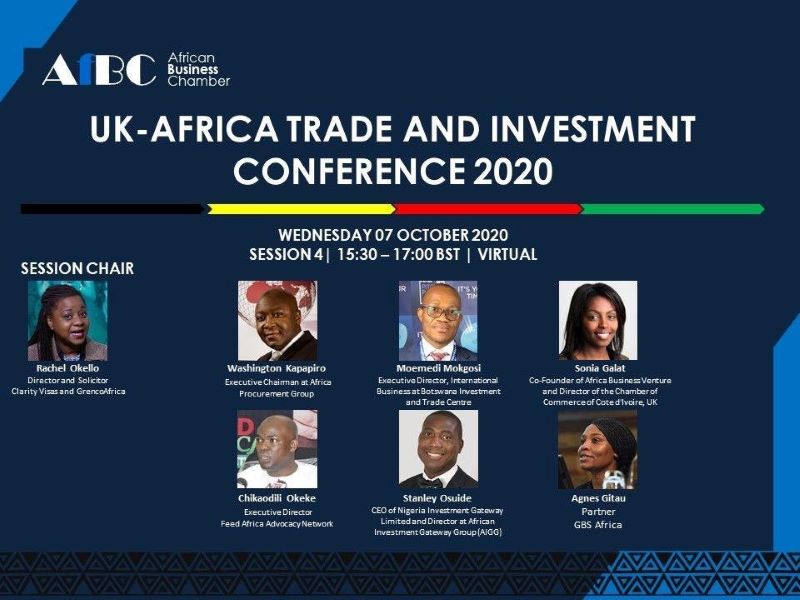
UK – AFRICA TRADE AND INVESTMENT CONFERENCE 2020

On Wednesday 7 October 2020, The Africa Business Chamber (AfBC) hosted the UK-Trade Trade and Investment Conference under the theme “Boosting Trade Linkages and Value Chains Between the UK and Africa – Unlocking and Capturing New Business Growth Opportunities” which brought together business leaders, government officials, investment diaspora, business experts, policy makers, academia and professionals from across various sectors around the world.

With over 30 million Africans living outside of their home countries, the continent’s diaspora has the potential to be a major source of development financing, skills and growth opportunities. The Summit explored investment and economic opportunities in the African region for global companies seeking new channels and consumer market growth, changes in local business climate, key trends and best practices to operate successfully on the continent.

With the introduction of the African Free Trade Continental Agreement, the official withdrawal of the United Kingdom from the European Union (Brexit) and the impact of the COVID-19 pandemic, policymakers are prompted to act fast in order to seize opportunities that these events offer while resetting the United Kingdom – Africa trade relations to result in an emergence of a win-win partnership. In 2016, Africa’s exports to the UK stood at US$16.89 billion, registering a marginal 1.96% increase. On the flipside, there is untapped export potential from Africa to the U.K which depicts significant trade deficit gaps.

The aim is to strength multilateral relationships between the UK’s partnership with African nations, in order to build a secure and prosperous future for all its citizens through the mobilization of new and sustainable investments thus resulting in the creation of jobs and the boosting of mutual prosperity through the frameworks of the Africa Continental Free Trade Agreement (AfCFTA) and the global trade Economic Partnership Agreements (EPAs). The AfCFTA is estimated bring Africa annual income gains of US$134 billion per year, as it creates the largest free trade area by the number of countries with an amalgamated market size worth more than US$3 trillion, consumer business spending over US$6.7 trillion and free movement of about 1.3 billion people.

This prestigious gathering saw a number of world leaders coming together with the same goal in mind – to grow and foster the trade between the United Kingdom and Africa. Among the notable change makers in attendance were Keith Stoke Smith, Lord Dolar Popat, Emma Wade OBE, Andrew Mold, Dr El-hadj Baj as Keynote Speakers. Washington Kapapiro, President of the Global African Business Club, engaged all the leaders on ‘The Role of African Diaspora and Remittances’ with a core focus on the impact that economic development presents in the context of UK and African trade.
Written by Molebogeng Assegaai


The importance of youth participation in trade and governance matters

The youth in Africa are considered to be the continent’s biggest resource as they make up a significant percentage of the African continent’s population, it is estimated that almost 60% of Africa’s population is made up by young people under 25 years old., making Africa the world’s youngest continent.

However, youth participation in the African economy, more especially, in cross-border trade and governance matters is still very limited.  Young people on the continent are confronted with many challenges ranging from economies that grew but could not create sufficient employment prior to the global economic crisis, to insufficient security, education and poor healthcare systems. 

Across many African countries, youth unemployment is a significant problem that is most stringent for young females; with young women and minorities being disproportionately affected. Statistics show that just over one in five youth were not employed, in education or training (NEET) in 2019. This state of joblessness has been steadily growing since 2012 mirroring the trends in the global rate. While education alone is not enough, it remains a vital ingredient for empowering the youth.  

Given the high unemployment and vulnerable employment rates for youth, young African leaders deserve to be part of policy discussions that seek to address the challenge of youth participation on various platforms ranging from trade supported by trade governance, economic participation, policy reform discussions and social justice issues thus contributing to reducing inequalities by distributing benefits equally across all segments of society. There’s a significant gap between those deciding policy and those who have to weather its effects as most African leaders are 55 years old or older. It is imperative that young people take up space and reinforce constitutional accountability from organisational levels right up to the presidential level, with this being said, the integration of technology and the access to new technologies coupled with self-organisation is important for the implementation of youth led programs and policies.  

The development of the ‘African Continental Free Trade Agreement’ as a continent wide Free Trade Agreement (FTA) for Africa, is set to integrate 55 sovereign States that are at very different levels of economic development throughout the continent. The FTA requires that these states comply with a wide range of obligations and regulations in order to liberalise trade. Despite the challenges that have been presented in integrating 55 sovereign States with different economic disparities; progress in many areas has been impressively swift. The AfCFTA, if properly implemented, could provide more, and better jobs that are sorely needed for Africa’s sustainable development. Political will and a commitment to reform will nevertheless be necessary to tap into the huge potential of Africa’s young labour force and ensure that the gains from economic integration are distributed fairly across the continent.

Meaningful participation by all groups of society including marginalised groups such as women and youth in trade and policy making processes can contribute to achieving inclusive sustainable growth and development for the African continent, as well as social stability. ‘If the energies and ambitions of Africa’s youth continue to be wasted, they could become serious destabilising forces, threatening not only just future progress, but rolling back the gains of recent years.’(Mo Ibrahim Foundation) 

Therefore, in order to be drivers of international trade, the youth should take heed to the lessons and experiences learnt from gender mainstreaming in trade in order develop and adapt tools to assess the impact of trade policy on young people. 

GABC shared vision of supporting Women Affairs

Global Africa Business Club is a private network club made up of 1% crowd who trade in-country, regionally and overseas.  Our philosophy is embedded in the pan-African globalisation.  At the heart of pan-Africanism is strengthening the bonds between all people of African descendent.  In Southern Africa we call this “Ubuntu.”  Globalisation is an process of integration between people, companies and government worldwide.  By combining both the process and ideology GABC seeks to strengthen all African people, all African governments and all African businesses through a process of commercial integration that transcends all regional and international borders through collaborative efforts with key stakeholders entrusted to the development of realizing Africa’s potential.  GABC has identified three strategic focus areas that are our channels of this initiative:

  • Women Affairs
  • Global Youth Development
  • Charitable Giving: Orphans and Vulnerable Children

On the 27thSeptember GABC launched in South Africa its Head Quarters after operating in the UK for 14 years representing African Diasporas living in the UK.  I accepted the invitation to represent the organization as the Director of Women Affairs. I gave a 10-minute introductory about Women Affairs and quoted the following:

“…to be truly empowered, women must develop their power base, advocate for reform, and exert their own leadership to change their operating environment politically, culturally, and economically.” – The Centre for International Private Enterprise (CIPE).

Note that empowerment is gender neutral.  That means, building (1) a power base, (2) advocating for reform, and (3) using one platform of leadership to change operating environments in political; cultural and economic systems is in essence the empowerment personified and manifested in both genders: men & women.

We all know the role of women in an inclusive system.  We have seen the stats and many evidence-based reports that speak of how Women continue to remain an untapped resource needed to strengthen governance and economic prosperity, despite the needle moving positively towards more woman who can hold office and run multi-dollar billion enterprises.  What is the problem?  The problems often are institutional legacies inherit in political and cultural systems. Women across the sub-Sahara continue to face formal legal barriers related to ownership of property, registration of businesses and access to commercial loans.  This has implications on their ability to participate in both a market and non-market economy.  As a response to this crisis GABC serves to be a voice of African business community bring together business from all backgrounds, including women in business, women in corporates, women in government and facilitate private sector participation in transparent policy debate advocating for reform to create a more inclusive economy.  What is unique about GABC is that unlike other organizations that are male-dominated and often under represent the importance of advocating policy solutions to promote women in the economy, GABC supports private sector organizations that better represent the needs of women in business in the policy-making process and become advocates of reform.

On the 20thNovember 2018, GABC will be hosting a roundtable discussion to help private sector organizations in countries such as Nigeria, South Africa, Tanzania and Kenya focus more strategically on recruiting and representing female members, both through internal reforms and engagement with decision-makers and other stakeholders. Combining the historical expertise of GABC engagement with business leaders and regional representatives of policy makers, this roundtable is aiming to help build the capacity of regional business associations to better engage women in policymaking process and promote inclusive growth. Building political systems that deliver is at the core of strengthening political reforms on the continent and around the world, creating sustainable development. By supporting enterprises, private sector and associations to be more inclusive of women and address the political and economic aspirations of women, GABC is strengthening socio-economic systems and assist women and the families they support become advocates of reform in their communities.

FOR IMMEDIATE RELEASE

The Government Network announces the launch of their Crowdsale for the development of a borderless Nation powered by Blockchain Technology, operating from a Decentralised Autonomous Organisation (DAO).

Belize, October 31, 2018, The Government Network is building a borderless Nation powered by Blockchain Technology, operating from a Decentralised Autonomous Organisation (DAO). Its purpose is to innovate governance one step at a time through the implementation of applications serving direct market needs as drivers for the ecosystem. The goal is to build a nation, operating on a decentralised governance model, accessible and free for all, that empowers its citizens with abilities to achieve their goals independently through the power of technology.

The framework under which the different branches and procedures of the Government Network will operate will be determined by a Constitutional Convention. Here, an equally represented group of prominent experts, businessmen and humanists will be tasked with rethinking the role of government as we know it. The Constitutional Convention will be organised starting from March 2019.

The Crowdsale aims to secure $ 3 million in funding to be used for the further strengthening of the parallel task groups building the Nation, with a first focus on completing the foundation required to develop the DAO and the initial front-end applications. These applications will function as drivers for the Nation and will be equipped with a user base through partnerships. The applications include a decentralised self-sovereign identity solution, a trusted trade framework, and a basic community engagement platform.

Furthermore, the Government Network will invest in testing the different assumptions on which the Nation will be built, the onboarding of new citizens, and educating the world on our new form of governance absent of national boundaries and free from the traditional centralized national models.

Now raising capital by launching a Crowdsale through its own cryptocurrency called the GOV Token, an ERC 20 token based on the Ethereum blockchain. The Government Network Crowdsale commences on November 1, 10:00 AM GMT and will run for 4 weeks.

For complete information, please visit: https://thegovernment.network/token-saleTo download the whitepaper, please visit:

https://thegovernment.network/docs/The-Government-Network-White-Paper.pdf

Media Contact: press@thegovernment.networkGeneral enquiries: info@thegovernment.network

Borderless Thinking – Purposeful Thinking

As we launch the Global Africa Business Club (GABC) an exclusive private business network on Thursday 27 September 2018 under the theme “Borderless Thinking” we reflect on the challenges and opportunities to promote pan-african globalization on the continent.   Why are we launching it?  GABC has been planning and scoping across the continent in 2018 and because we have been in all four corners of the continent we are now ready to launch. 

What is next step after the launch? First and foremost we must develop purposeful programs that enable us to impact the market economies we serve.  Africa is home to some of the fastest growing economies: Ghana Ethiopia, Nigeria, Angola, South Africa, Cote d’Ivoire, Djibouti, Senegal and Tanzania.  Therefore, Africa is strategically positioned for robust trade between countries but what continues to be our biggest barrier is high tariffs between countries and the unrelenting increasing costs of oil prices that affects the cost of transporting goods and services to the consumer and customer (retailer).

GABC strives to create a world where African enterprises can trade without borders; creating a borderless mindset.  GABC’s purpose is enshrined in raising the level of consciousness to connect people and organizations to ideas and programs so that they can be strengthened to continue to live out their purpose.   Oprah Winfrey reminds us of this when she says “when you align who you have become in the world, with what you have come to do in the world you have found your purpose.” That is why GABC’s organizational excellence begins with you, our members and your commitment to building and strengthening African enterprises and African institutions to create and preserve our indigenous knowledge systems. 

We look forward to being the voice of African business on the continent.  

GABC welcomes you!

Mr. Washington Kapapiro
Chairman